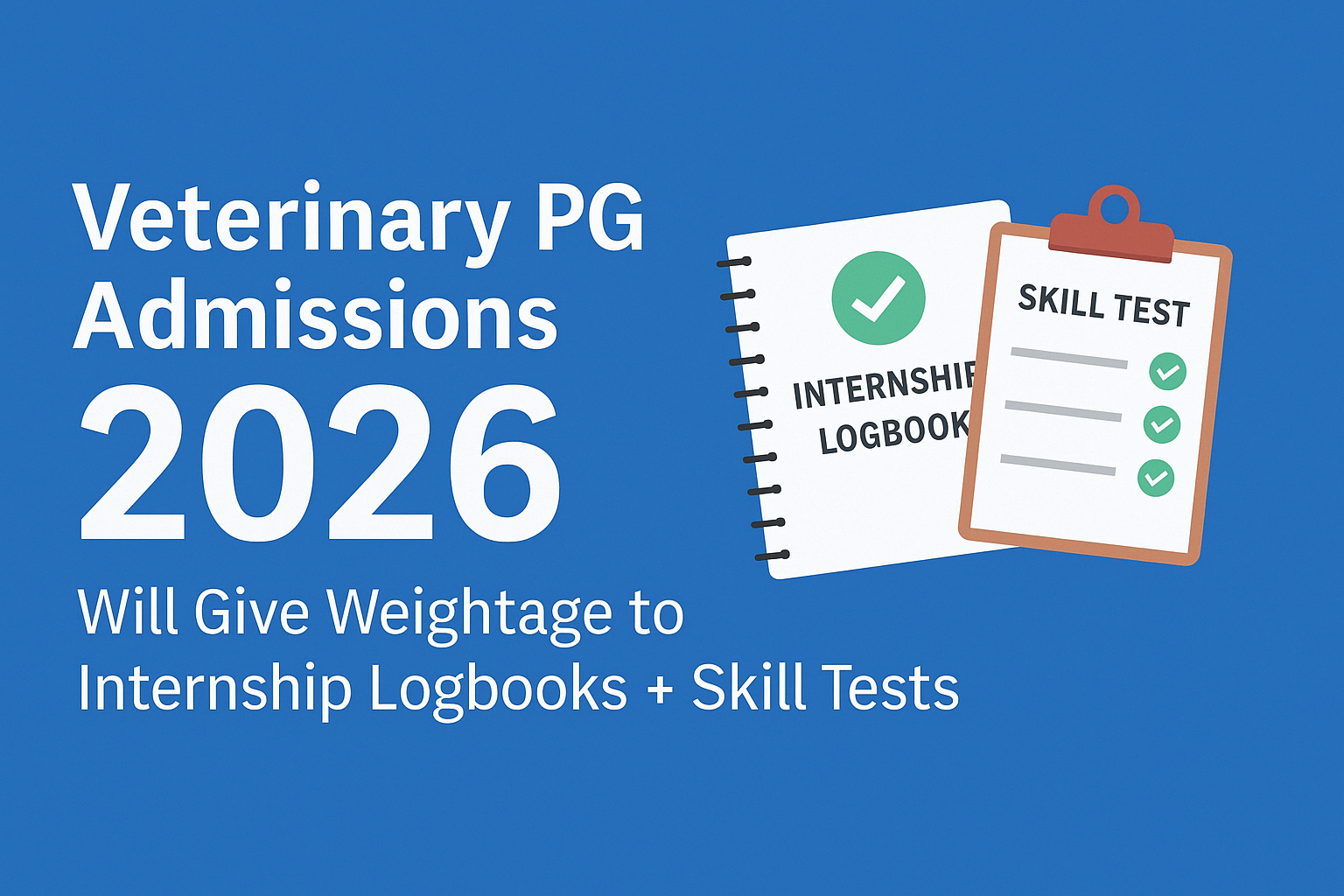
Veterinary education in India is undergoing major changes. From 2026 onwards, the PG admission process for M.V.Sc programs is expected to give significant weightage to a student’s internship logbook, hands-on clinical skills, and practical competencies, instead of relying on theory marks alone.
This shift aligns with global veterinary standards and the updated expectations of ICAR, veterinary councils, and state universities. The goal is to produce veterinarians who are clinically skilled, job-ready, and competent in real-world farm and hospital settings.
⭐ Why PG Admissions Are Changing in 2026
1️⃣ Skill gap in fresh graduates needs correction
Universities have observed that even high-scoring students sometimes lack:
- surgical handling ability
- clinical confidence
- farm-level disease management skills
- emergency decision-making
- reproductive exam proficiency
Therefore, practical ability is becoming a core admission factor.
2️⃣ Internship logbooks show a student’s real work
The internship logbook records:
- cases handled
- surgeries assisted
- farm visits
- diagnostic procedures
- vaccinations performed
- laboratory experience
- hands-on training
This gives universities a true picture of the student’s competence.
3️⃣ ICAR & VCI shifting towards competency-based veterinary training
India is gradually adopting the Competency-Based Veterinary Education (CBVE) model, similar to global veterinary schools.
This means PG seats will focus on:
- skills
- attitudes
- practical exposure
- communication ability
- decision-making
—not just exam scores.
4️⃣ Industry demand is changing
Dairy, poultry, clinical hospitals, pet care chains, wildlife centres, and pharma companies want vets who can:
- diagnose confidently
- perform minor surgeries
- handle emergencies
- collect samples
- interpret lab reports
- communicate with farmers & pet owners
Universities want PG students who are ready for these responsibilities.
⭐ How Veterinary PG Admissions May Work in 2026
The expected model includes multiple evaluation components:
✔ 1. Internship Logbook Weightage (20–40%)
Universities will check:
- number of clinical cases handled
- quality of documentation
- surgeries assisted/observed
- diagnostic skills
- farm practice ability
- behaviour & punctuality
- attendance
A well-maintained logbook will be a major advantage.
✔ 2. Skill-Based Tests (OSCE / OSPE) (20–30%)
Students may have to demonstrate skills such as:
- IV/IM injection
- basic suturing
- sample collection
- animal handling
- rectal exam basics
- clinical reasoning
- interpreting test reports
- emergency stabilisation steps
Objective Structured Clinical Exam (OSCE) ensures every candidate is tested fairly.
✔ 3. Written Test or Merit Marks (20–30%)
Marks still matter but will no longer be the only factor.
Theory knowledge is important, but practical competency has equal value.
✔ 4. Interview or Aptitude Test (10–20%)
Some universities may include:
- interest in specialization
- research goal
- communication skill
- attitude & ethics
- motivation for pursuing PG
This helps select genuinely passionate candidates.
⭐ What This Means for BVSc Interns
From 2024–2026, interns must take logbooks seriously.
Interns should focus on:
✔ Recording every clinical case properly
✔ Learning core skills (suturing, palpation, deworming schedule, etc.)
✔ Actively assisting in surgeries
✔ Spending more time in medicine, surgery, reproduction units
✔ Participating in health camps
✔ Improving farm-level disease management knowledge
✔ Attending emergency cases
✔ Maintaining ethical & professional behaviour
A complete and honest logbook will become a primary document during PG admissions.
⭐ Universities Benefit Too
This new policy helps veterinary colleges select:
- better-skilled PG candidates
- future clinicians with hands-on ability
- research students who understand field realities
- more confident and trained professionals
Clinical departments will see more prepared and motivated PG students.
⭐ What Students Should Start Doing Now (2024–2026)
- Keep logbooks neat, complete, and up to date
- Take internship rotations seriously
- Practice clinical procedures repeatedly
- Learn basic surgery steps
- Improve communication with farmers & pet owners
- Attend workshops and skill labs
- Build a strong portfolio of cases
Strong practical grounding increases PG chances significantly.
More Articles You May Like