Foot-and-Mouth Disease (FMD) remains one of the most important livestock diseases in Asia. Traditional vaccines work, but they come with challenges such as frequent boosters, cold-chain needs, matching strain issues, and limited protection window.
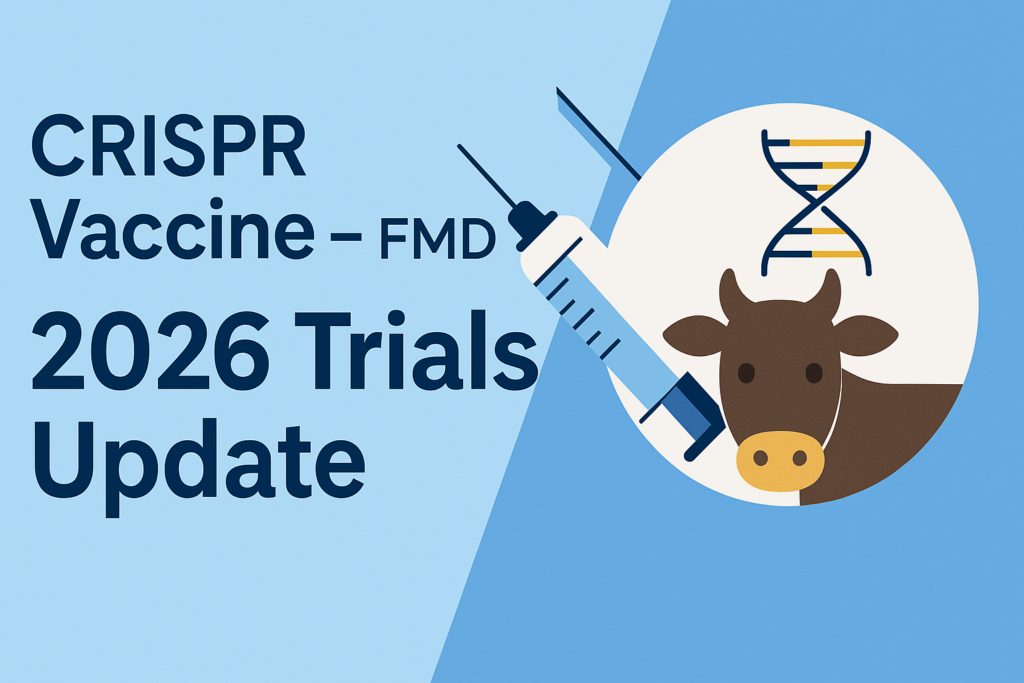
In 2026, new trials using CRISPR-based vaccine technology have shown major progress. This update explains what CRISPR vaccines are, how they work, their benefits, trial status, safety, and what farmers can expect in the coming years.
What Are CRISPR-based FMD Vaccines?
CRISPR technology allows scientists to edit or deactivate specific viral genes safely.
For FMD, this technology is used to:
- Remove harmful parts of the virus
- Keep only the immune-triggering regions
- Create a vaccine that trains the animal’s body to recognise the real virus
- Improve safety and stability
The result is a precision-designed vaccine, stronger and cleaner than conventional inactivated vaccines.
Why Scientists Are Developing CRISPR FMD Vaccines
FMD spreads fast across cattle, buffalo, sheep, goats and pigs. Outbreaks affect milk output, trade, farm income and animal health. Traditional vaccines can protect, but they have limitations:
- Protection drops after a few months
- Booster doses are frequent
- Some strains evolve and escape immunity
- Manufacturing is slow and complex
CRISPR aims to fix these issues through faster development, accurate targeting and longer immunity.
How CRISPR FMD Vaccines Work
CRISPR-based vaccines follow a clear scientific process:
1. Identify the strongest immune-triggering parts of the FMD virus
These remain unchanged even when strains mutate.
2. Use CRISPR to disable harmful genes
This ensures the vaccine cannot cause disease.
3. Insert or rearrange immune-relevant elements
This improves recognition by the animal’s immune system.
4. Formulate the vaccine for cattle, buffalo and small ruminants
Different species can receive adjusted combinations.
5. Test for safety, antibody production and long-term protection
Trials measure:
- Neutralising antibody levels
- Cellular immune response
- Duration of protection
- Side-effects
- Field performance
2026 Trials Update: What Is New
The 2026 trial update shows strong progress in several key areas:
Improved Immunity Duration
Animals showed longer antibody presence, reducing booster needs.
Better Cross-Strain Coverage
CRISPR-designed antigen sets covered multiple serotypes more reliably.
Strong Safety Profile
Since harmful viral sections are removed precisely, the trial animals had very low adverse reactions.
Faster Manufacturing
CRISPR platforms allow vaccine redesign to match new strains quickly if needed.
Thermostability Advancements
Some trial formulations remained effective at higher temperatures, lowering dependence on refrigeration.
Small-Ruminant Testing Initiated
Goats, sheep and pigs showed promising early immune responses.

Benefits for Farmers and the Industry
If approved after the final evaluation, CRISPR FMD vaccines could offer major advantages:
- Longer protection period
- Fewer booster doses
- More reliable during outbreaks
- Better fit for tropical climates
- Rapid update if new FMD strains appear
- Higher safety due to precise gene editing
- Potential cost reduction over time
These improvements directly support dairy, meat and livestock-based livelihoods.
Is a CRISPR Vaccine Safe?
CRISPR does not mix with the animal’s genetic material.
It only edits the virus used in the vaccine.
Trials so far show:
- No disease caused by the vaccine
- No impact on fertility
- No effect on milk or meat quality
- No altered genetics in animals
- No long-term negative reactions reported
Safety monitoring will continue throughout 2026-2027.
When Will It Be Available?
As of the 2026 update:
- Laboratory trials are successful
- Controlled field trials are ongoing
- Large-scale national field trials may begin after approval
- Commercial availability is expected only after all regulatory checks
Farmers should continue using existing approved FMD vaccines until official announcements.
Why CRISPR FMD Vaccine Trials Matter
India has one of the world’s largest cattle and buffalo populations.
A stronger FMD vaccine means:
- Fewer outbreaks
- Higher milk production
- Reduced farm losses
- Stable exports
- Lower treatment expenses
- Reliable immunity
CRISPR technology can help create a future-proof FMD control system.
CRISPR-based vaccines for Foot-and-Mouth Disease represent a major improvement in animal health technology. The 2026 trials show strong immunity, cross-strain coverage, safety, and manufacturing benefits. While more testing is required before widespread adoption, this approach could significantly strengthen India’s FMD control efforts in the coming years.
Farmers are advised to follow standard FMD vaccination schedules until official release of the new formulations.