Farmer extension models are changing quickly in India. Traditional, government-supported methods are now combined with modern, market-driven systems.
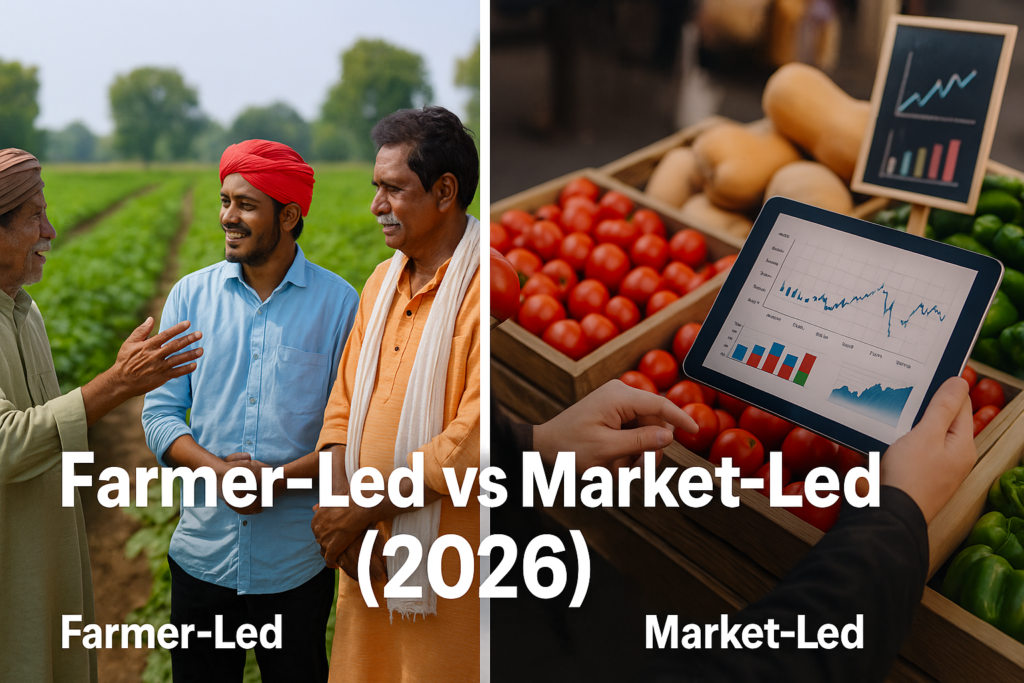
In 2026, both farmer-led extension and market-led extension play major roles in agriculture, but their goals, methods, and impact are very different.
This article explains both approaches in simple language and highlights the clear differences.
Quick Overview – 2026 Extension Models
| Aspect | Farmer-Led Extension | Market-Led Extension |
|---|---|---|
| Main Driver | Farmers | Agribusiness, Private Companies |
| Focus Area | Local needs, practical field solutions | Market demand, commercial value |
| Knowledge Flow | Farmer → Farmer | Company/Market → Farmer |
| Cost | Low | Medium to High |
| Technology Use | Moderate | High (Apps, sensors, advisory platforms) |
| 2026 Importance | Strengthens community learning | Improves income through market links |
What is Farmer-Led Extension?
Farmer-Led Extension is a knowledge-sharing method where farmers take the lead in learning, experimenting, and teaching others.
It focuses on local solutions, low-cost practices, and farmer experience, especially for small and marginal farmers.
Key Features
- Decisions are taken by farmers, not external agencies.
- Includes farmer field schools, lead farmers, and group demonstrations.
- Encourages traditional wisdom, climate adaptation, and low-cost innovations.
- Suitable for villages, tribal regions, and small-scale farming.
Why it matters in 2026
- Climate variations require local adaptation.
- Government schemes promote community knowledge hubs.
- Farmers trust fellow farmers more than any other source.
What is Market-Led Extension?
Market-Led Extension is a commercial-oriented model where market demand, private companies, agri-startups, and agribusiness networks guide the extension activities.
The aim is to help farmers produce what the market wants and earn better income.
Key Features
- Information flows from companies, market analysts, processors, exporters.
- Focus on high-demand crops, value chains, grading, and quality standards.
- Uses digital platforms, advisory apps, remote sensing, and price prediction tools.
- Strong link with contract farming, FPOs, and export markets.
Why it matters in 2026
- Increasing demand for high-quality produce in domestic & global markets.
- Digital agriculture platforms are expanding rapidly.
- Youth farmers prefer market-connected farming.
Detailed Difference Between Farmer-Led Extension and Market-Led Extension
1. Knowledge Source
- Farmer-Led: Knowledge comes from experienced farmers, grassroots experiments, community learning.
- Market-Led: Knowledge comes from companies, buyers, retailers, exporters, and digital advisory systems.
2. Objective
- Farmer-Led: Improve farming skills, solve field problems, encourage sustainable practices.
- Market-Led: Increase profitability by connecting production to market demand.
3. Approach
- Farmer-Led: Bottom-up. Farmers decide what works.
- Market-Led: Top-down. Market signals decide what to grow.
4. Technology Use
- Farmer-Led: Low to moderate; demonstration plots, local training.
- Market-Led: High; apps, AI-based forecasting, e-market platforms, digital grading.
5. Cost
- Farmer-Led: Very affordable; mostly supported by government/community.
- Market-Led: Costs may involve inputs, technology, and company services.
6. Scale
- Farmer-Led: Best suited for village or cluster level.
- Market-Led: Works in large areas, especially for commercial crops.
7. Benefits (2026 Perspective)
Farmer-Led Extension:
- Improves self-reliance
- Supports climate-friendly practices
- Strengthens community bonds
Market-Led Extension:
- Ensures better prices
- Reduces market risk through demand forecasting
- Boosts value-added farming, grading, export quality
Which is Better in 2026?
There is no single “best” method.
Most Indian states in 2026 use a combination:
- Farmer-Led for training, sustainability, low-cost improvements
- Market-Led for income, export opportunities, and technology adoption
A mixed model gives farmers both knowledge and market advantage.